Category: Uncategorized

  • Pre-Stretched vs Standard Stretch Film: Where the Savings Really Come From

    Pre-Stretched vs Standard Stretch Film: Where the Savings Really Come From

    Stretch film is one of the few warehouse consumables where the cost is set less by what you buy than by how it is applied. Two facilities can wrap identical pallets, buy film at the same price per pound, and still see their film bills diverge by a third or more — because one of them is drawing far more raw plastic off the roll than the load actually needs. Pre-stretched film is the product built around closing that gap. Understanding what it does, and where it quietly falls short, is the difference between a real saving and a switch that leaves your loads looser than before.

    What “Pre-Stretch” Actually Means

    Ordinary stretch film arrives on the roll at its full thickness and is stretched as it is applied. Pre-stretched film is drawn out at the factory first — some products are pulled to roughly 90 percent of their capacity, close to the point where the film would break — and then wound onto the roll in that already-elongated state. The result is a thinner film that suppliers commonly describe as delivering similar strength at around half the thickness of a conventional equivalent. In effect, the stretching work that would normally happen in your warehouse has already been done in the plant, and you are buying the film in the condition it would end up in anyway.

    The Number That Explains the Savings

    The reason this matters comes down to a single, uncomfortable figure: when film is applied by hand, operators typically achieve only about 15 to 25 percent stretch. Good film is engineered to stretch several times that — powered wrapping machines routinely run pre-stretch settings of 150 to 300 percent — so a hand-wrapped pallet is leaving most of the roll’s yield unused, paying for plastic that never does any work. Every extra bit of stretch you coax out of the film means fewer meters drawn from the roll to get the same number of turns around the load.

    A worked example makes it concrete. A pallet with a roughly two-meter perimeter, wrapped for eighteen revolutions, needs about thirty-six meters of film in contact with the load. Drawn with no stretch at all, that is thirty-six meters off the roll. At a machine pre-stretch of 250 percent, the same coverage takes barely more than ten meters of raw film. Pre-stretched film brings a chunk of that efficiency to hand application, where operators otherwise never get close to it.
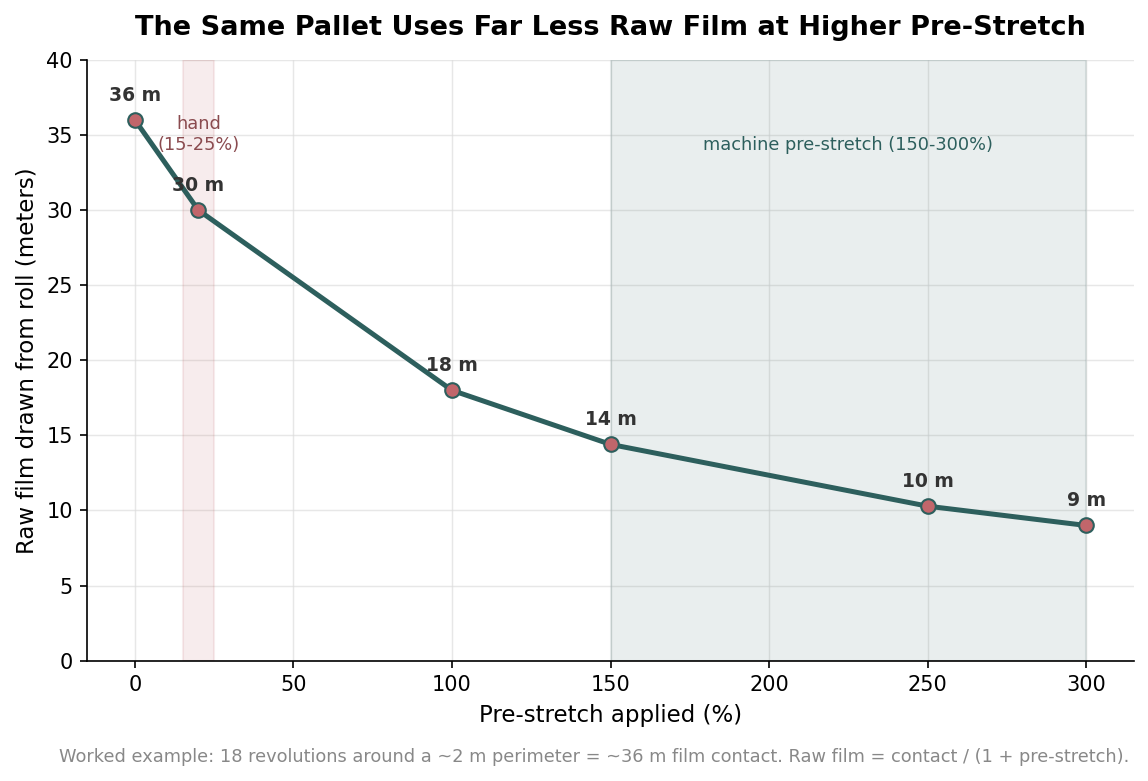
    Line chart showing raw film drawn from the roll falling from 36 meters at zero stretch to about 10 meters at 250 percent pre-stretch for one worked pallet
    For one worked pallet, raw film drawn drops steeply as pre-stretch rises; hand wrapping sits at the far left.

    Where the Material and the Money Go

    Because a pre-stretched roll is thinner and already elongated, less plastic goes onto each pallet. Suppliers commonly report film-use reductions in the range of 25 to 40 percent, and in some hand-wrap operations replacing standard film the drop is larger still. The savings are not only in material. A pre-stretched roll can weigh on the order of two-thirds less than a conventional roll of comparable coverage, which is a real ergonomic gain for staff wrapping pallets by hand all day, and on automatic equipment the reduced film draw lowers motor load and energy use. Fewer roll changes, lighter lifting, and less plastic per load add up across a shift. There is a disposal angle too: less film applied per pallet means less film to pay to haul away or recycle at the other end, which is easy to overlook when only the purchase price is on the invoice.
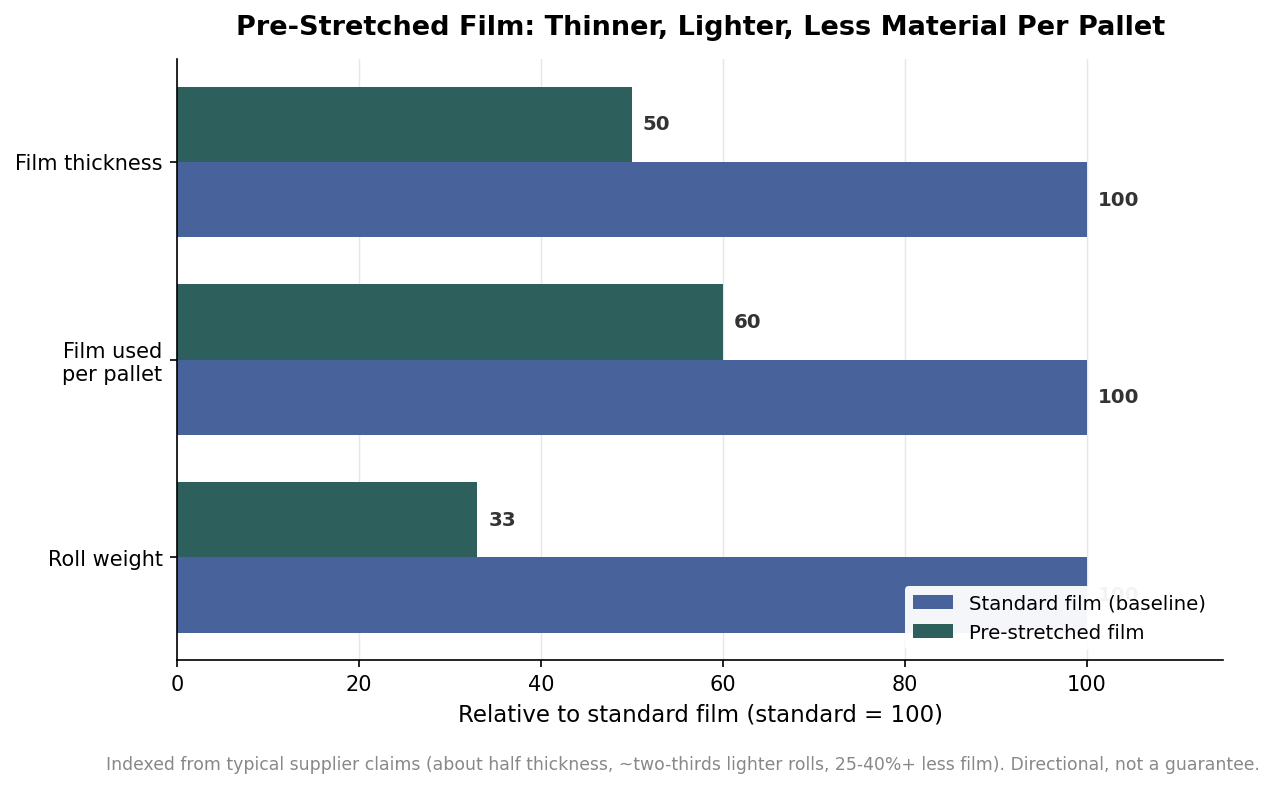
    Horizontal bar chart indexing pre-stretched film against standard film at 100 for thickness, film used per pallet, and roll weight
    Pre-stretched film indexed against standard film: thinner, lighter rolls and less material per pallet. Directional supplier-typical figures.

    Where Pre-Stretch Isn’t the Answer

    Thinner film is a trade, not a free lunch. A film that has already given up most of its stretch at the factory has less reserve and, at a given point on the load, less raw material standing between a sharp corner and a puncture. For heavy, rigid, or sharp-edged freight — unbanded steel, exposed pallet nails, dense irregular stacks — a thicker standard gauge or a purpose-built reinforced film often protects the load better than a very thin pre-stretched one, even though it costs more per pallet. Pre-stretch also rewards good technique: because there is less margin to hide a bad wrap pattern, the base wraps at the pallet foot and a consistent spiral up and down the load matter more, not less. Matching gauge to load remains the first decision — light, stable cartons tolerate a thin high-yield film that a drum of hardware would tear through.

    Specifying It for a Branded Run

    If you are ordering custom-printed film, the same logic applies, with a couple of extra checks. Decide first whether the film will be applied by hand or by machine, because that sets which pre-stretch grade and gauge make sense; a hand-applied branded film sees very different tension than one running through a powered pre-stretch head. Ask the supplier for the roll’s yield expressed as square feet or square meters per roll rather than judging by roll diameter, since a thinner high-yield roll can out-cover a fatter conventional one. Establish a baseline of how many revolutions and how many rolls your current setup uses per pallet, so you can measure any change honestly after switching. And wrap a few real loads with a sample before committing a full print run, checking both containment and puncture on your actual freight.

    The figures here are industry-typical ranges, not quotes — stretch percentages, yields, and savings all depend on your film, your equipment, and your loads — so treat them as the shape of the opportunity and confirm the specifics with sample rolls and your supplier’s yield data before you rewrite the standing order.
  • Stretch Wrap Mistakes That Wreck Loads and Inflate Your Film Bill

    Stretch Wrap Mistakes That Wreck Loads and Inflate Your Film Bill

    Most stretch wrap problems are not really film problems. They are settings, habits, and stacking decisions that were wrong before the roll ever touched the load. The film gets blamed because it is the part that visibly fails, splitting at a corner or peeling loose in the trailer, but the cause is usually upstream. Here are the mistakes that quietly cost money and lose loads, and what the fix actually looks like on the dock.

    Mistake one: buying gauge when the load needs containment force

    Gauge measures the film’s thickness, and it is the number most buyers fixate on. What actually holds a pallet together is containment force, the pressure the wrapped film exerts inward on the load, measured in pounds per linear inch. A thick film applied loosely can deliver less containment than a thinner film applied with proper tension and pre-stretch. Chasing gauge alone is how warehouses end up paying for heavy film that still lets loads shift.

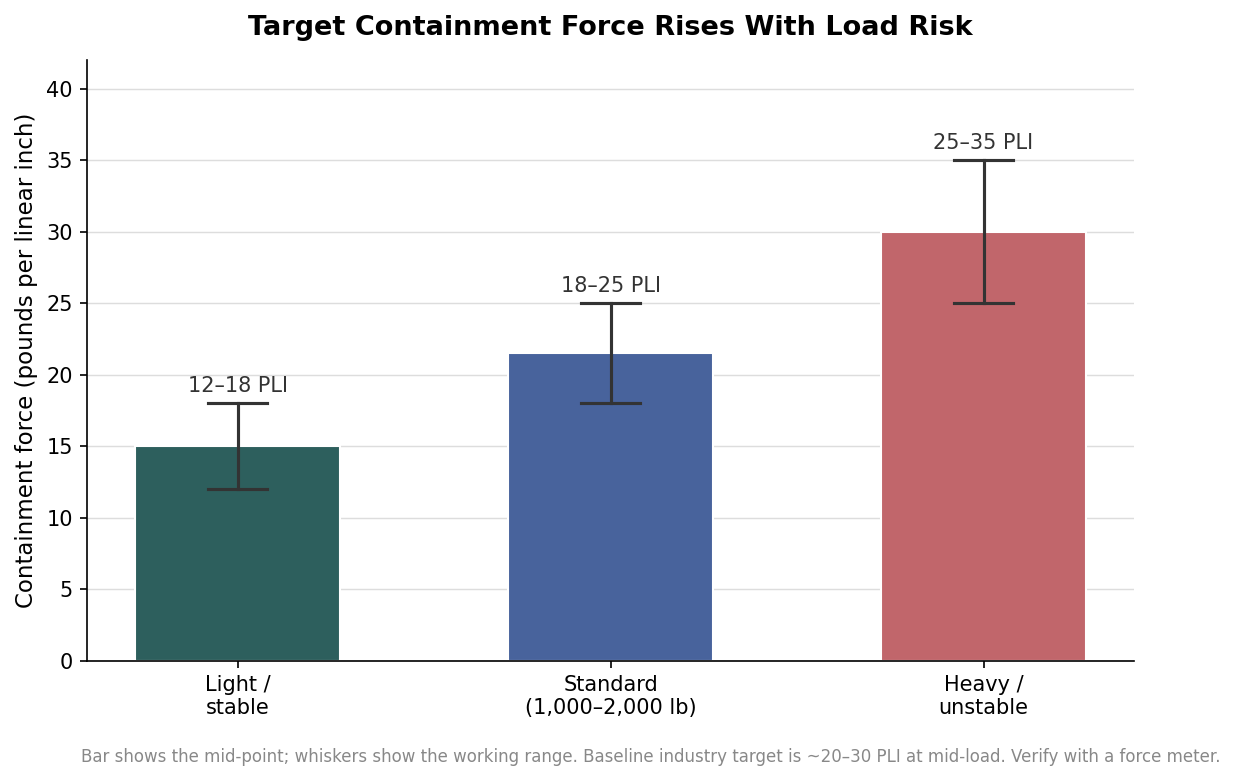
    The working targets are well established. A light, stable load may only need containment in the low teens, standard loads of roughly 1,000 to 2,000 pounds are usually specified around 18 to 25 pounds per linear inch, and heavy or unstable loads climb to 25 to 35. The commonly cited baseline is 20 to 30 pounds per linear inch measured at the mid-load point. You cannot judge this by feel with any precision. A handheld containment force meter turns it into a real number, and the rough palm push test against the mid-load film is only a directional check between meter readings.

    Bar chart of target stretch wrap containment force in pounds per linear inch by load type, from about 12-18 PLI light to 25-35 PLI heavy
    Set the containment force target from the load’s risk, then pick the lightest gauge that delivers it.

    Specify the load by the force you need to hold it, then choose the lightest gauge that reliably delivers that force on your equipment. That order of operations is what separates a spec from a guess, and it is where over-buying quietly disappears.

    Mistake two: leaving pre-stretch on the table

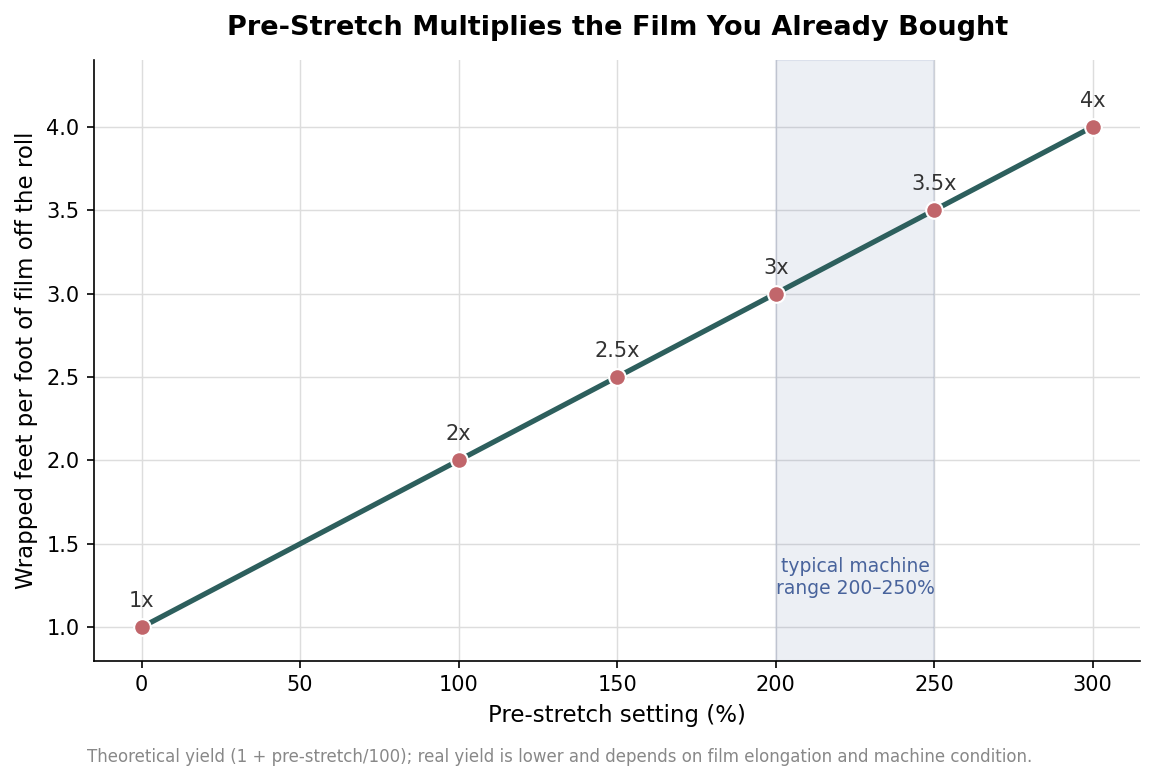
    Pre-stretch is the film being elongated before it reaches the load, and it is the single biggest lever on film cost. A machine set to 200 percent pre-stretch turns one foot of film off the roll into roughly three wrapped feet, and 250 percent pushes that toward three and a half. Typical machine film runs comfortably in the 200 to 250 percent range, yet plenty of operations leave it far below that, either because the machine is set conservatively or because hand wrapping does no pre-stretch at all.

    Line chart showing wrapped feet per foot of film rising with pre-stretch percentage, reaching about 3x at 200 percent
    Pre-stretch is the biggest lever on film cost: 200 percent turns one foot into roughly three.

    The catch is that pre-stretch and containment force have to be tuned together. Push pre-stretch too high for a given film and it necks down, loses width, and starts breaking at corners, which sends operators back toward thicker film and undoes the saving. The productive move is to raise pre-stretch incrementally while watching for edge tearing, and to pair it with a film rated for the elongation you are asking of it. Done right, the same load is held with materially less plastic, which is the rare change that cuts cost and waste at the same time. Treat these percentages as indicative and confirm the sweet spot on your own film and machine.

    Mistake three: skipping the base anchor and shorting the wraps

    A pallet load fails at its weakest connection, and the weakest connection is usually the joint between the load and the pallet itself. Wrapping the boxes beautifully while never tying them to the pallet leaves the whole stack free to slide off in transit. The fix is to anchor the film to the pallet at the base, often by twisting the film into a rope for the first turns so it bites into the pallet, then building coverage up and back down with meaningful overlap.

    Coverage is the other half. As a floor, a load needs enough revolutions to genuinely contain it, commonly at least five turns for a hand-wrapped pallet, with extra wraps concentrated at the top and bottom where the load wants to move most. When wrapping by hand, twisting the film every other rotation adds bite without adding rolls. Too few turns is a false economy: the film saved is trivial next to the cost of one toppled load, a damaged product, or an injury on the dock.

    Mistake four: wrapping a load that was doomed on the stack

    No wrap setting rescues a bad stack. Pyramid stacking, mixed box sizes, and heavy cartons riding on top of light ones all build instability that film can only paper over. The load should be columnar where possible, with boxes aligned edge to edge, the heaviest cartons on the bottom, and a flat top surface for the film to grip. Overhang is its own failure mode, since any box hanging past the pallet edge has no support beneath it and concentrates stress right where the film is thinnest.

    The pallet underneath matters just as much. A cracked deck board, a protruding nail, or a pallet slightly too small for the load will each undermine an otherwise perfect wrap. Reject damaged pallets, match the pallet footprint to the cargo so nothing overhangs, and slip a layer of board between tiers of an unstable load to spread the force. Fixing the stack is cheaper than compensating for it with more film, and it is the step most likely to be skipped under time pressure.

    What getting it right looks like on the dock

    A well-wrapped pallet is boring to look at and boring in the trailer, which is the goal. It starts from a containment force target rather than a gauge preference, uses pre-stretch aggressively but within the film’s limits, anchors to the pallet before building coverage, and sits on a sound stack and a sound pallet. Get those four right and the film almost stops being a variable. Branding the wrap then becomes a bonus rather than a distraction, because a load that arrives intact is the only advertisement a warehouse actually needs. Where the figures above are given as ranges, use them as a starting point and dial in the exact numbers against your own loads, film, and equipment.

  • Cast vs. Blown Stretch Film: A Spec-by-Spec Comparison

    Cast vs. Blown Stretch Film: A Spec-by-Spec Comparison

    Cast and blown stretch film both wrap a pallet, both stretch, and both hold a load together in transit. But they are made by different extrusion processes, and those processes give each film a distinct personality on the loading dock. Choosing between them is not about which is universally better. It is about matching the film’s strengths to the loads you actually ship, the equipment you run, and the way your product gets handled downstream.

    The short version: cast film is the clear, quiet, budget-friendly generalist, while blown film is the tougher, higher-retention specialist that costs more and runs louder. The rest of this guide walks through where those differences come from and how to weigh them for your operation.

    How each film is made

    Cast film is produced by cast extrusion. Molten resin is spread onto a chilled roller that cools it almost instantly, which produces a film with very consistent gauge and high optical clarity. Because the process is fast and efficient, cast film generally carries a lower cost per roll and unwinds quietly off the roll, a small detail that matters when hand wrappers pull hundreds of rolls a week.

    Blown film is made by blown extrusion. The resin is forced through a circular die and inflated into a bubble that cools in the air more slowly. That slower, molecular-alignment-heavy cooling is what gives blown film its toughness, its high load-holding force, and its characteristically hazy, cloudy look. The same process makes it noisier to unwind and more expensive to produce.

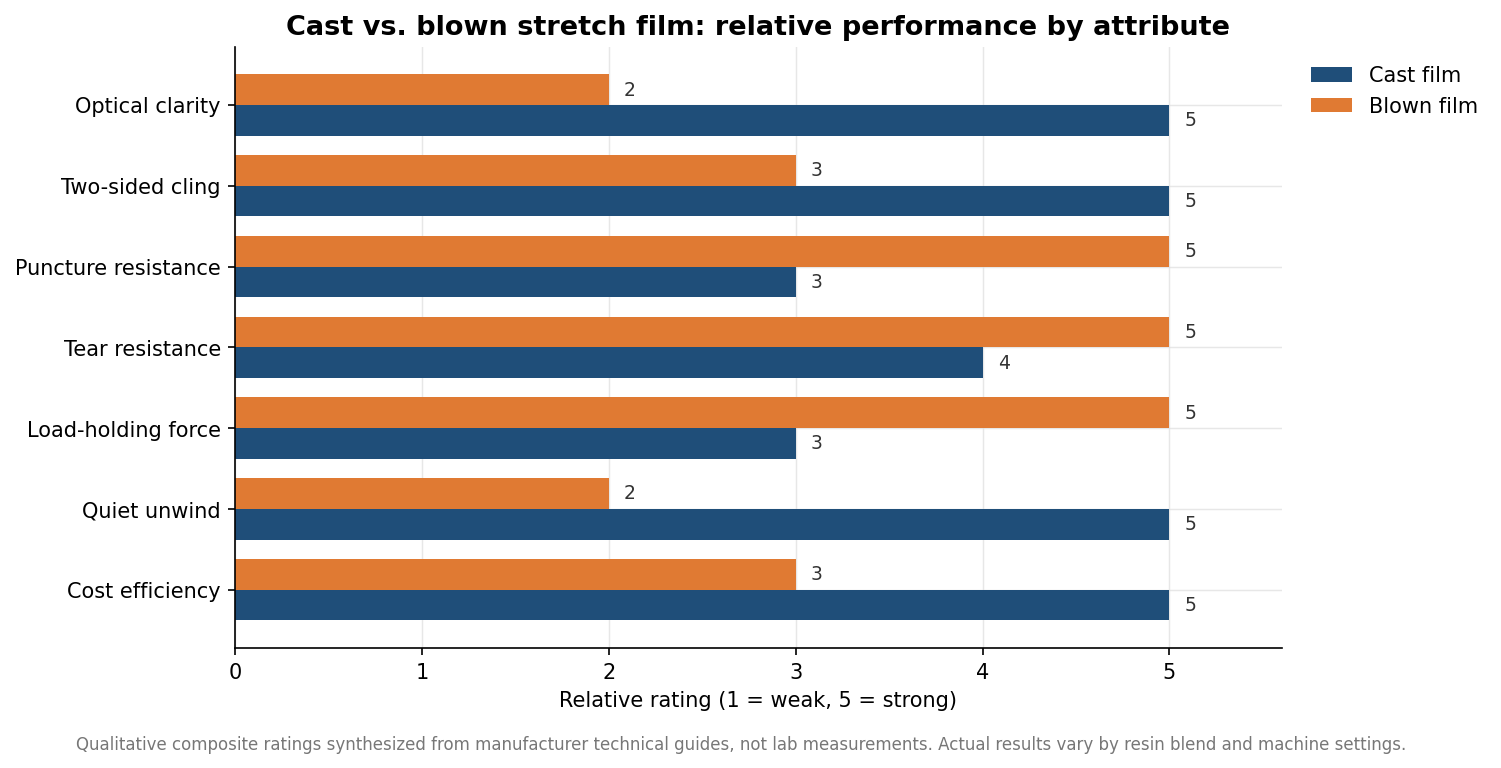
    Grouped bar chart comparing cast and blown stretch film across seven performance attributes
    Cast film leads on clarity, cling, quiet unwind, and cost; blown film leads on puncture, tear, and load-holding force.

    The properties that actually differ

    Clarity and cling favor cast film. Its glossy transparency makes it easy to read barcodes and shipping labels through the wrap, and its strong two-sided cling holds a load without excessive wrapping. Blown film is cloudier and typically offers cling on one side only, which some operations actually prefer because wrapped pallets do not stick to each other in storage.

    Puncture and tear resistance favor blown film. If you ship engine parts, lumber, machined components, or anything with sharp corners, blown film resists the punctures and propagating tears that would cut through cast film of the same thickness. Blown film also has higher load-holding force, meaning it keeps applying inward pressure over a long truck ride rather than relaxing.

    Cost and noise favor cast film. For comparable gauge, cast film usually sits below blown on price, and it releases quietly. Blown film commands a premium and produces a loud tearing sound on every wrap, which is a genuine ergonomic consideration in a manual wrapping station staffed all day.

    Reading gauge the right way

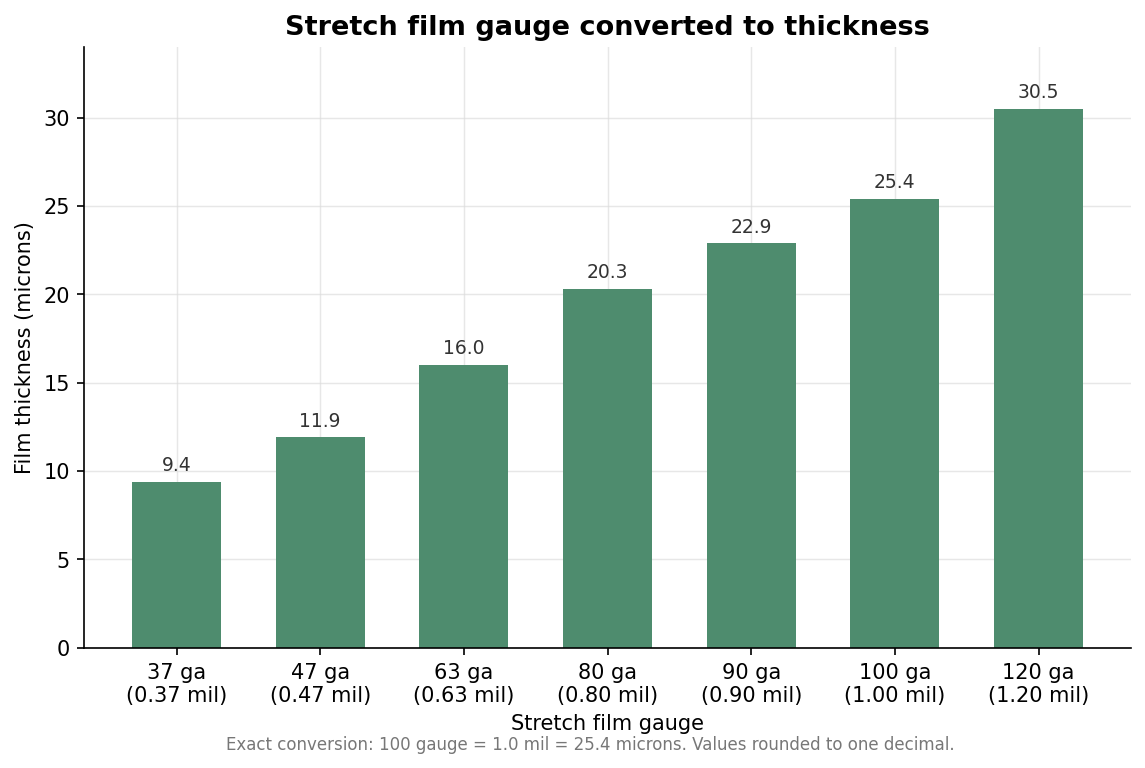
    Thickness is where buyers most often overspend. In the United States, film thickness is quoted in gauge, and the conversion is fixed: 100 gauge equals 1.0 mil, which equals 25.4 microns. A 80-gauge film is 0.80 mil, or about 20.3 microns. The chart below shows the common gauges converted to microns so you can compare a domestic spec sheet against a metric one without guessing.

    Gauge interacts with film type. Because blown film carries more load at a given thickness, some operations can step down a gauge or two when they switch from cast to blown and still hold the same load, offsetting part of blown film’s higher unit price. The only reliable way to confirm that is a containment-force test on your own pallets rather than a spec-sheet comparison.

    Bar chart converting common stretch film gauges to thickness in microns
    Common stretch film gauges converted to microns using the fixed 100 gauge = 1 mil = 25.4 micron relationship.

    Pre-stretch and machine wrapping

    Modern powered pre-stretch wrappers elongate the film before it reaches the pallet, and this is where cast film’s economics shine. Cast film commonly pre-stretches in the range of 200 to 300 percent, so one pound of film covers far more surface area than an unstretched roll would suggest. Blown film generally pre-stretches less but starts from a higher baseline strength. When you compare films, compare the wrapped cost per pallet after pre-stretch, not the sticker price per roll, because a cheaper roll that stretches less can end up costing more per load.

    For guidance on selecting and testing film, ASTM D4649, the standard guide for the selection and use of stretch wrap films, is the reference most packaging engineers point to. It frames the decision around load containment force and film performance rather than thickness alone, which is exactly the mindset that keeps you from over-buying.

    Which one should you order

    Choose cast film when your loads are uniform and reasonably light to medium, when you need clear visibility of labels through the wrap, when quiet operation matters, or when unit cost is the deciding factor. It is the sensible default for boxed goods, palletized consumer products, and most general warehousing where loads are stable and handling is routine.

    Choose blown film when loads are heavy, sharp-edged, or irregular, when you need maximum holding force for a long or rough transit, or when one-sided cling is a storage advantage. The premium pays for itself when a failed wrap means a toppled or damaged load.

    If your operation runs a mix of load types, there is no rule against stocking both and matching the film to the pallet. Many well-run docks do exactly that, matching cast film to clean boxed loads and reserving blown film for the heavy or sharp shipments that need it, and it is often cheaper over a year than forcing every shipment onto a single compromise film. Whichever you standardize on, the wrap is also prime branding real estate, so specifying a custom-printed film in your chosen construction lets the same roll protect the load and carry your name through the supply chain.

  • Sustainable Pallet Wrap: Three Levers That Actually Cut the Plastic

    Sustainable Pallet Wrap: Three Levers That Actually Cut the Plastic

    Pallet wrap is one of the most-used and least-examined materials in any warehouse. It is also squarely in the sights of retail sustainability mandates, packaging-waste rules, and customers asking suppliers to prove they are cutting plastic. The awkward part is that the film is doing real work — a pallet that arrives collapsed or leaning is a bigger environmental and financial loss than the wrap that failed to hold it. So the goal is not to use less film for its own sake; it is to move the same load with less virgin plastic, and to recover what you do use. Three levers do most of that work, and none of them require giving up a branded, custom-printed film.

    Start with what the film actually is

    Nearly all stretch wrap is linear low-density polyethylene (LLDPE), which carries recycling category number four. That single fact shapes the whole sustainability picture. Polyethylene film is genuinely recyclable, but almost never through curbside bins — it tangles in the sorting machinery at material recovery facilities. It goes back into the stream through store drop-off and dedicated thin-film collection, the same channel as grocery bags, and networks like plasticfilmrecycling.org list the drop-off points. The encouraging news for a warehouse is that stretch film is far easier to recycle than household packaging, because it is generated clean and in bulk at a central location rather than scattered across thousands of homes. That makes recovery economically viable in a way it rarely is for consumer plastics — which is exactly why the recover step later is so important.

    Lever one: use less film per pallet

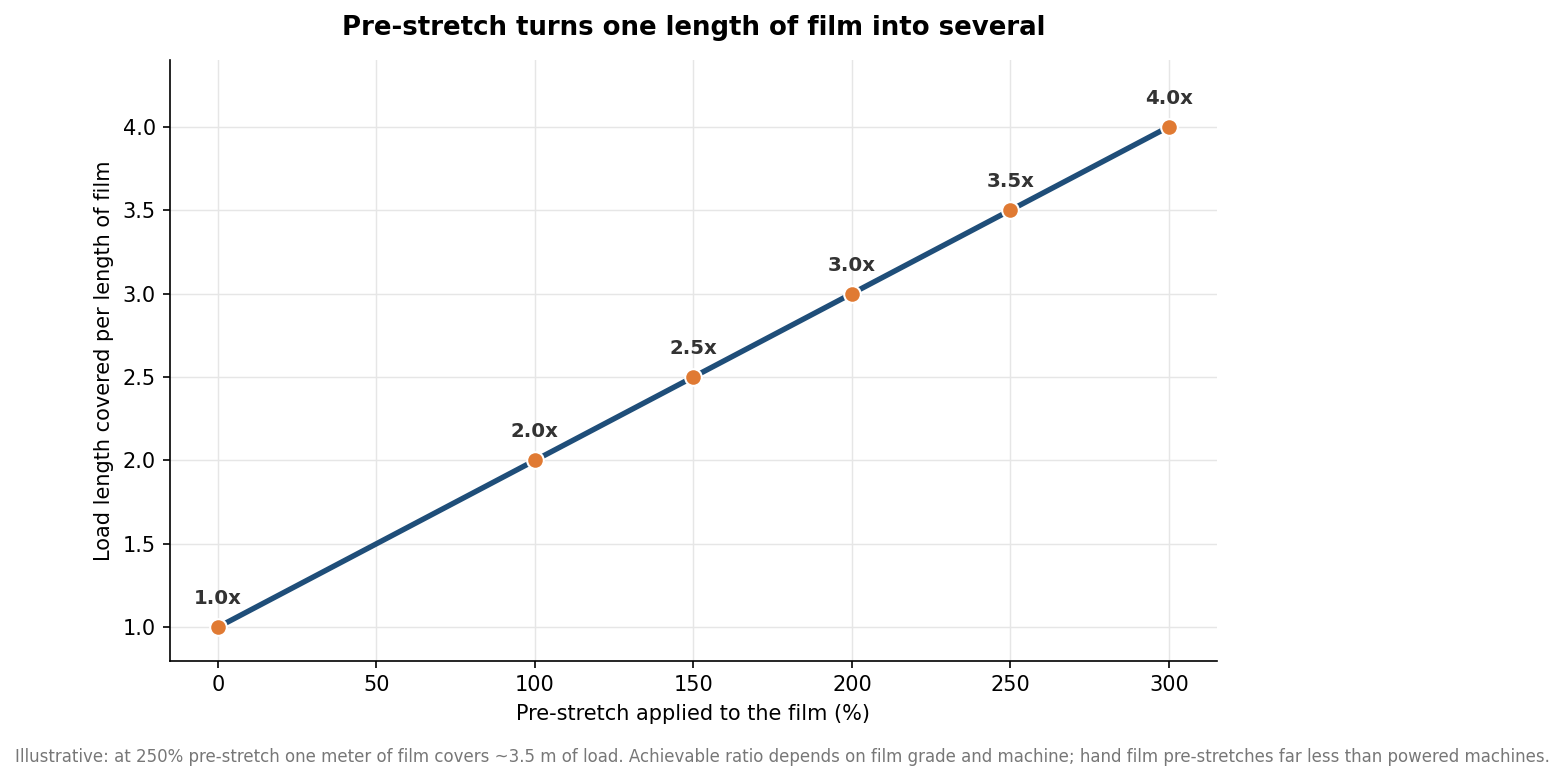
    The largest and cheapest win is applying the film more efficiently, and the key mechanism is pre-stretch — elongating the film before it touches the load so each length covers more pallet. A powered machine can commonly pre-stretch film on the order of 200 to 300 percent, meaning one meter of film is drawn out to three or four meters before it wraps. Hand wrapping achieves far less, which is one reason high-throughput operations move to powered equipment.

    Line chart showing how pre-stretch percentage increases the load length covered per length of stretch film, from 1x at 0 percent to 4x at 300 percent
    Pre-stretch is the biggest source-reduction lever: at 250% one length of film covers about 3.5 lengths of load.

    Down-gauging works alongside pre-stretch. High-performance thin films are engineered to deliver strong load-holding force at a fraction of the thickness of older film: a stiff 55-gauge film can hold a load that once needed 80-gauge or heavier, using markedly less plastic per turn. The catch, as film engineers are quick to point out, is that thinner does not automatically mean less film used — a thin film applied with a poor wrap pattern or too many wasted revolutions can burn through as much plastic as a thicker one. The discipline that ties it together is measurement: cut the film off a correctly wrapped, stable pallet, weigh it, and use that as your benchmark. Optimizing pattern and pre-stretch against a measured target is how down-gauging turns into real reduction rather than a spec-sheet claim.

    Lever two: put recycled content into the film

    Once you are using less film, the next step is making that film less virgin. Post-consumer recycled (PCR) content is now available in machine and hand stretch films, commonly in the range of 10 to 30 percent, with products on the market at 25 percent post-consumer and higher total recycled content. Much of it is cast film made from recovered polyethylene — in the best case genuine film-to-film material rather than downcycled rigid plastic. There is an honest trade-off: recycled resin can slightly reduce clarity and puncture resistance, so a film that has to stretch aggressively or show a barcode through the wrap may cap out at a lower PCR percentage than a general-purpose film. The practical move is to specify the highest PCR level that still passes your load-stability test, not the highest number on the datasheet.

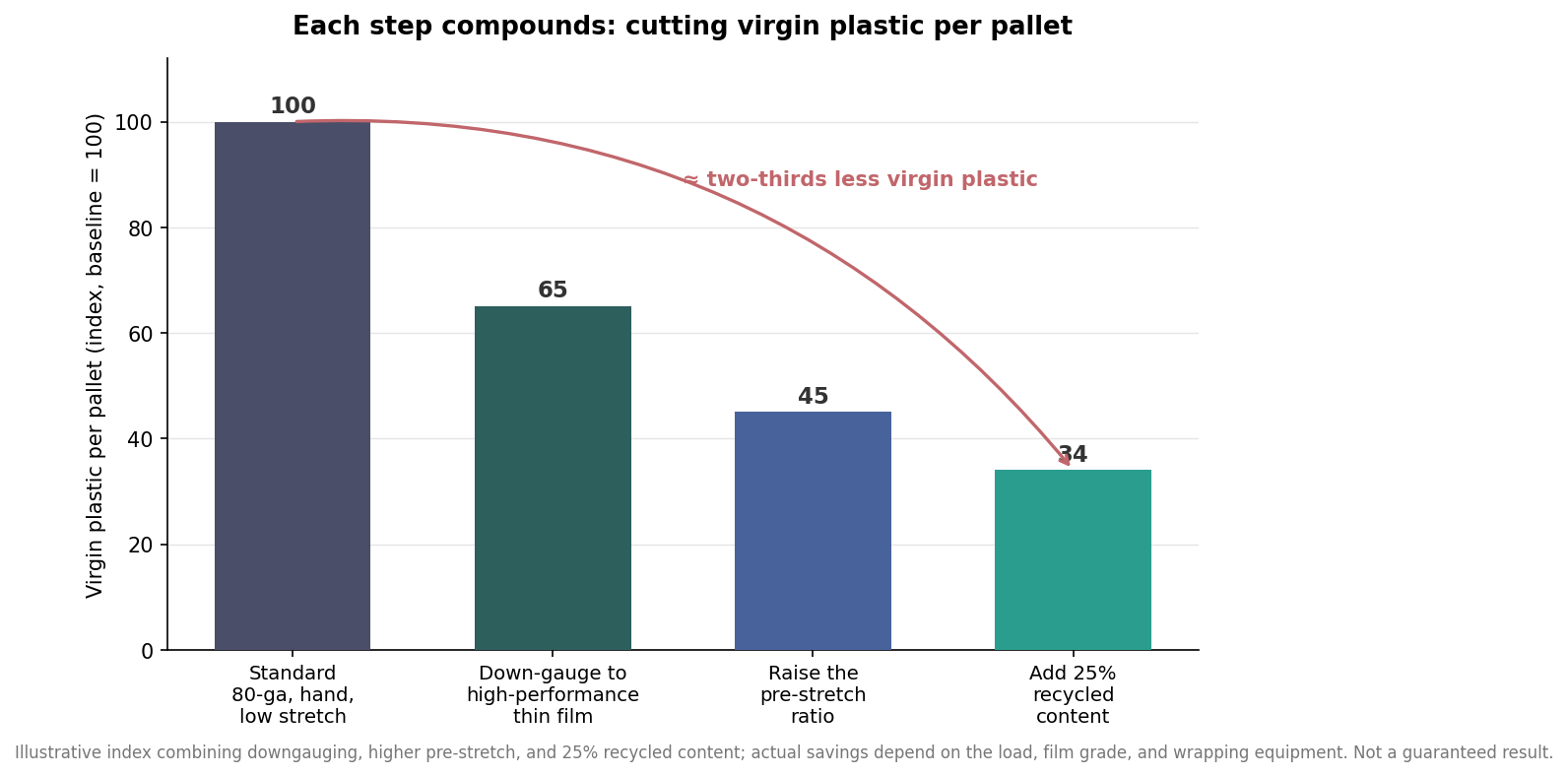
    Bar chart showing an illustrative index of virgin plastic per pallet falling from 100 to 34 across down-gauging, higher pre-stretch, and 25 percent recycled content
    Down-gauging, higher pre-stretch, and recycled content compound to a roughly two-thirds cut in virgin plastic per pallet.

    Stacked together, these levers compound. A warehouse that down-gauges to a high-performance film, raises its pre-stretch ratio, and then specifies recycled content can cut the virgin plastic behind each pallet substantially — the illustration above shows how the steps multiply rather than simply add. Treat the exact figure as directional; the point is that the reductions stack.

    Lever three: recover the film you do use

    Even an optimized operation still consumes film, and the sustainability story is only complete if that film comes back. Because a warehouse generates stretch wrap clean and concentrated, it is well suited to baling: collect the used film, keep it dry and free of tape and labels, compact it in a baler, and sell or hand it to a film recycler. Clean, baled LLDPE has real resale value, and diverting it from the dumpster both reduces disposal cost and closes the loop that makes PCR film possible in the first place. Setting up a simple capture point at the unwrapping station is often the highest-impact change a facility can make, because it converts a waste stream into feedstock.

    Watch the claims, and don’t trade away stability

    Two cautions keep a sustainability program honest. First, be skeptical of films sold as “biodegradable” or “oxo-degradable” — many simply fragment into smaller pieces of plastic under specific conditions rather than truly composting, and several jurisdictions now restrict those claims. Recyclable PCR polyethylene is generally the more defensible route for industrial film. Second, never let a sustainability spec quietly reduce containment force below what the load needs; a failed pallet in transit wastes the product, the packaging, and the wrap all at once. Prove the new film holds the load first, then bank the plastic savings. A branded, custom-printed film sits comfortably on top of all three levers — the logo travels on a thinner, partly-recycled, recoverable wrap, which is a better marketing story than a plain one. Decide the film against your loads and your recovery setup, and “sustainable pallet wrap” becomes a measurable result rather than a label.

  • Hand vs. Machine Stretch Wrap: Which Do You Need?

    Hand vs. Machine Stretch Wrap: Which Do You Need?

    July 6, 2026 · Buyer guides

    The right film starts with how you wrap. Hand film and machine film are engineered differently, and using the wrong one wastes money and film.

    Quick comparison

    Hand filmMachine film
    Applied byA person, by handAn automatic/semi-auto wrapper
    Roll sizeShort, light rollsLong, heavy rolls
    Best forUnder ~50 pallets/dayHigh volume, consistent loads

    The rule of thumb

    If a machine wraps your pallets, you need machine film tuned to its pre-stretch. If people wrap by hand, use hand film — and consider pre-stretched hand film to cut fatigue. Crossing them over leads to breaks, poor containment, and wasted film.

    Get a quoteReady to spec your film? Get a custom quote — proof and pricing within one business day.

    Get a Quote

  • How to Choose the Right Stretch Film Gauge

    How to Choose the Right Stretch Film Gauge

    June 20, 2026 · Ordering

    Gauge is film thickness, and heavier is not always better — it just costs more. The goal is the lightest gauge that holds your load securely.

    Gauge by load

    LoadTypical gauge
    Light, stable (under 800 lb)47–60 ga
    Medium (800–2,000 lb)63–80 ga
    Heavy or irregular80–120 ga

    Don’t overpay

    Many operations wrap light loads in film that’s far heavier than needed. Modern high-performance and pre-stretched films deliver the containment of a heavier gauge at a lower one. Send us your load weights and we’ll spec the lightest film that holds.

    Get a quoteReady to spec your film? Get a custom quote — proof and pricing within one business day.

    Get a Quote

  • Branded Pallet Wrap: Turning Logistics Into Marketing

    Branded Pallet Wrap: Turning Logistics Into Marketing

    June 5, 2026 · Branding

    Every pallet you ship already travels through a chain of docks, trucks, and receiving bays. Printed stretch film turns that journey into brand impressions at almost no marginal cost.

    Why it works

    The film is a sunk cost — you’re buying it anyway. Adding a printed logo costs a small premium per roll but puts your name on every pallet across your entire outbound supply chain. It also doubles as tamper-evidence: a broken or re-wrapped logo pattern is obvious.

    The math

    Impressions per palletCost per impression
    Dozens across the supply chainFractions of a cent

    Few marketing channels are that cheap. Get a custom quote and put your brand on every load.

    Get a quoteReady to spec your film? Get a custom quote — proof and pricing within one business day.

    Get a Quote