Most stretch wrap problems are not really film problems. They are settings, habits, and stacking decisions that were wrong before the roll ever touched the load. The film gets blamed because it is the part that visibly fails, splitting at a corner or peeling loose in the trailer, but the cause is usually upstream. Here are the mistakes that quietly cost money and lose loads, and what the fix actually looks like on the dock.
Mistake one: buying gauge when the load needs containment force
Gauge measures the film’s thickness, and it is the number most buyers fixate on. What actually holds a pallet together is containment force, the pressure the wrapped film exerts inward on the load, measured in pounds per linear inch. A thick film applied loosely can deliver less containment than a thinner film applied with proper tension and pre-stretch. Chasing gauge alone is how warehouses end up paying for heavy film that still lets loads shift.
The working targets are well established. A light, stable load may only need containment in the low teens, standard loads of roughly 1,000 to 2,000 pounds are usually specified around 18 to 25 pounds per linear inch, and heavy or unstable loads climb to 25 to 35. The commonly cited baseline is 20 to 30 pounds per linear inch measured at the mid-load point. You cannot judge this by feel with any precision. A handheld containment force meter turns it into a real number, and the rough palm push test against the mid-load film is only a directional check between meter readings.
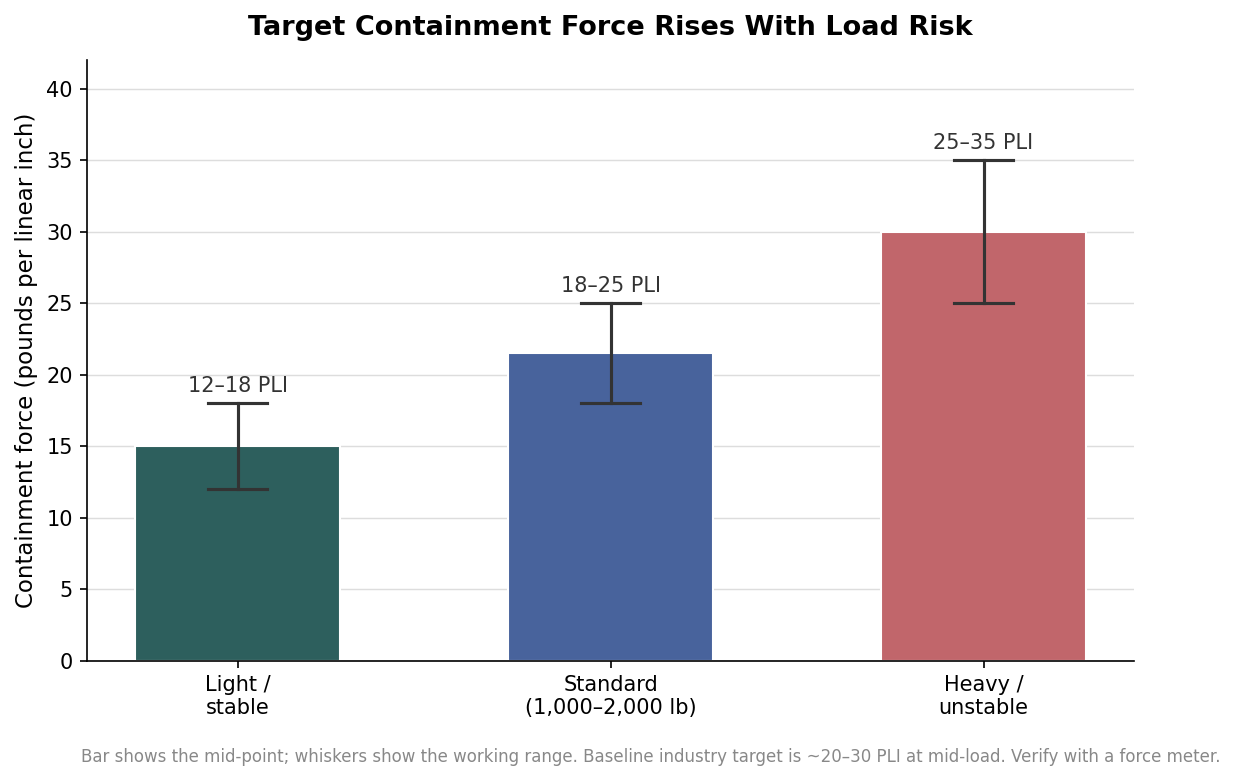
Specify the load by the force you need to hold it, then choose the lightest gauge that reliably delivers that force on your equipment. That order of operations is what separates a spec from a guess, and it is where over-buying quietly disappears.
Mistake two: leaving pre-stretch on the table
Pre-stretch is the film being elongated before it reaches the load, and it is the single biggest lever on film cost. A machine set to 200 percent pre-stretch turns one foot of film off the roll into roughly three wrapped feet, and 250 percent pushes that toward three and a half. Typical machine film runs comfortably in the 200 to 250 percent range, yet plenty of operations leave it far below that, either because the machine is set conservatively or because hand wrapping does no pre-stretch at all.
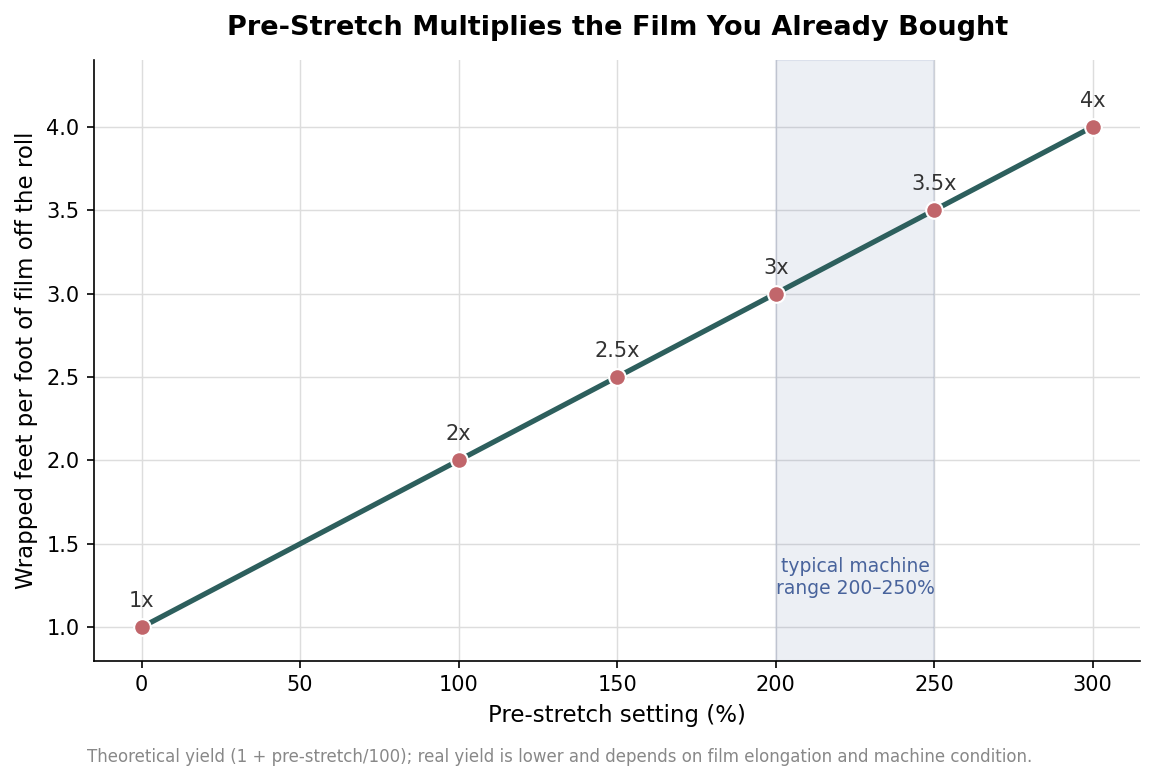
The catch is that pre-stretch and containment force have to be tuned together. Push pre-stretch too high for a given film and it necks down, loses width, and starts breaking at corners, which sends operators back toward thicker film and undoes the saving. The productive move is to raise pre-stretch incrementally while watching for edge tearing, and to pair it with a film rated for the elongation you are asking of it. Done right, the same load is held with materially less plastic, which is the rare change that cuts cost and waste at the same time. Treat these percentages as indicative and confirm the sweet spot on your own film and machine.
Mistake three: skipping the base anchor and shorting the wraps
A pallet load fails at its weakest connection, and the weakest connection is usually the joint between the load and the pallet itself. Wrapping the boxes beautifully while never tying them to the pallet leaves the whole stack free to slide off in transit. The fix is to anchor the film to the pallet at the base, often by twisting the film into a rope for the first turns so it bites into the pallet, then building coverage up and back down with meaningful overlap.
Coverage is the other half. As a floor, a load needs enough revolutions to genuinely contain it, commonly at least five turns for a hand-wrapped pallet, with extra wraps concentrated at the top and bottom where the load wants to move most. When wrapping by hand, twisting the film every other rotation adds bite without adding rolls. Too few turns is a false economy: the film saved is trivial next to the cost of one toppled load, a damaged product, or an injury on the dock.
Mistake four: wrapping a load that was doomed on the stack
No wrap setting rescues a bad stack. Pyramid stacking, mixed box sizes, and heavy cartons riding on top of light ones all build instability that film can only paper over. The load should be columnar where possible, with boxes aligned edge to edge, the heaviest cartons on the bottom, and a flat top surface for the film to grip. Overhang is its own failure mode, since any box hanging past the pallet edge has no support beneath it and concentrates stress right where the film is thinnest.
The pallet underneath matters just as much. A cracked deck board, a protruding nail, or a pallet slightly too small for the load will each undermine an otherwise perfect wrap. Reject damaged pallets, match the pallet footprint to the cargo so nothing overhangs, and slip a layer of board between tiers of an unstable load to spread the force. Fixing the stack is cheaper than compensating for it with more film, and it is the step most likely to be skipped under time pressure.
What getting it right looks like on the dock
A well-wrapped pallet is boring to look at and boring in the trailer, which is the goal. It starts from a containment force target rather than a gauge preference, uses pre-stretch aggressively but within the film’s limits, anchors to the pallet before building coverage, and sits on a sound stack and a sound pallet. Get those four right and the film almost stops being a variable. Branding the wrap then becomes a bonus rather than a distraction, because a load that arrives intact is the only advertisement a warehouse actually needs. Where the figures above are given as ranges, use them as a starting point and dial in the exact numbers against your own loads, film, and equipment.
Leave a Reply