Pallet wrap is one of the most-used and least-examined materials in any warehouse. It is also squarely in the sights of retail sustainability mandates, packaging-waste rules, and customers asking suppliers to prove they are cutting plastic. The awkward part is that the film is doing real work — a pallet that arrives collapsed or leaning is a bigger environmental and financial loss than the wrap that failed to hold it. So the goal is not to use less film for its own sake; it is to move the same load with less virgin plastic, and to recover what you do use. Three levers do most of that work, and none of them require giving up a branded, custom-printed film.
Start with what the film actually is
Nearly all stretch wrap is linear low-density polyethylene (LLDPE), which carries recycling category number four. That single fact shapes the whole sustainability picture. Polyethylene film is genuinely recyclable, but almost never through curbside bins — it tangles in the sorting machinery at material recovery facilities. It goes back into the stream through store drop-off and dedicated thin-film collection, the same channel as grocery bags, and networks like plasticfilmrecycling.org list the drop-off points. The encouraging news for a warehouse is that stretch film is far easier to recycle than household packaging, because it is generated clean and in bulk at a central location rather than scattered across thousands of homes. That makes recovery economically viable in a way it rarely is for consumer plastics — which is exactly why the recover step later is so important.
Lever one: use less film per pallet
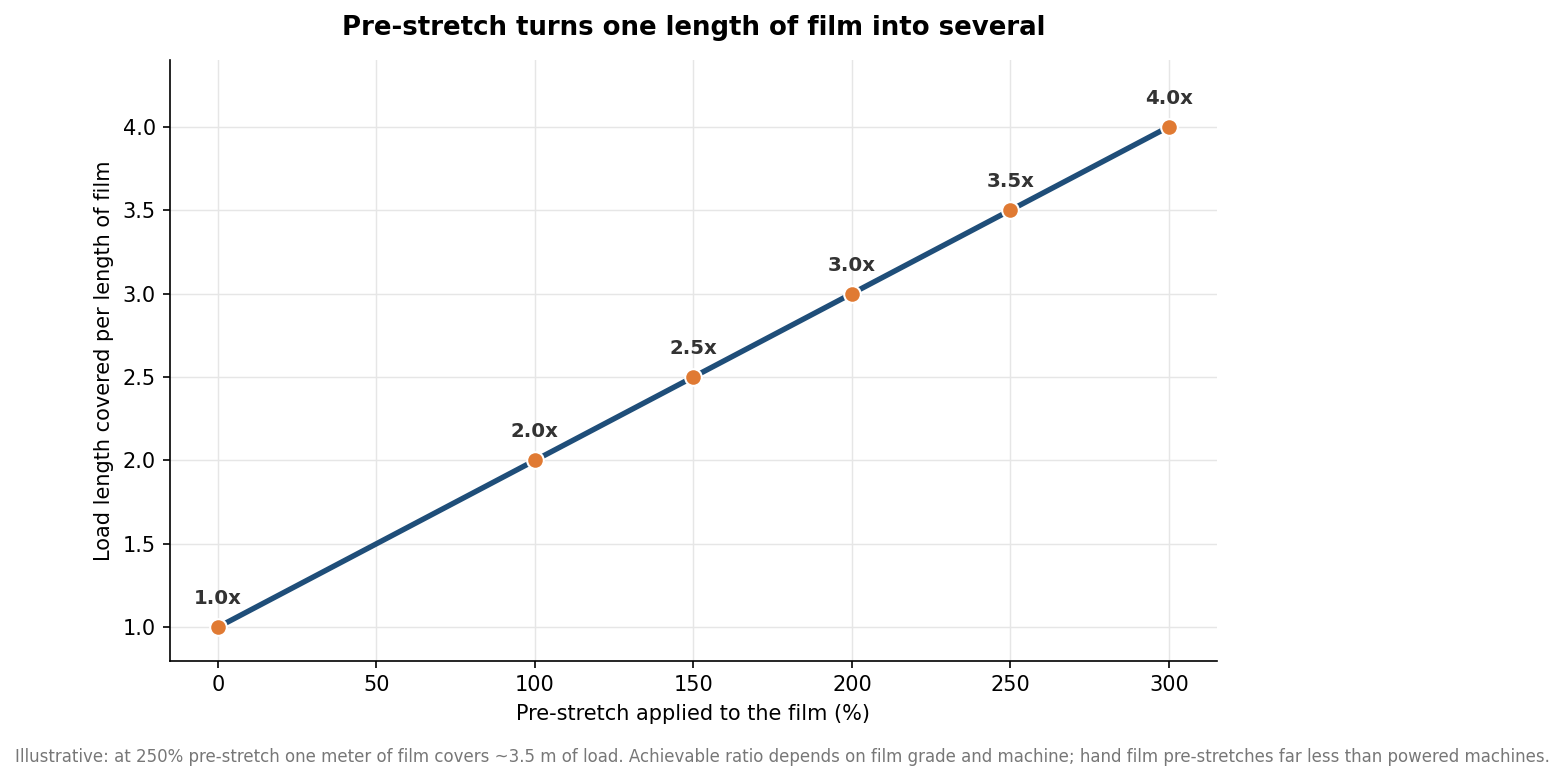
The largest and cheapest win is applying the film more efficiently, and the key mechanism is pre-stretch — elongating the film before it touches the load so each length covers more pallet. A powered machine can commonly pre-stretch film on the order of 200 to 300 percent, meaning one meter of film is drawn out to three or four meters before it wraps. Hand wrapping achieves far less, which is one reason high-throughput operations move to powered equipment.
Down-gauging works alongside pre-stretch. High-performance thin films are engineered to deliver strong load-holding force at a fraction of the thickness of older film: a stiff 55-gauge film can hold a load that once needed 80-gauge or heavier, using markedly less plastic per turn. The catch, as film engineers are quick to point out, is that thinner does not automatically mean less film used — a thin film applied with a poor wrap pattern or too many wasted revolutions can burn through as much plastic as a thicker one. The discipline that ties it together is measurement: cut the film off a correctly wrapped, stable pallet, weigh it, and use that as your benchmark. Optimizing pattern and pre-stretch against a measured target is how down-gauging turns into real reduction rather than a spec-sheet claim.
Lever two: put recycled content into the film
Once you are using less film, the next step is making that film less virgin. Post-consumer recycled (PCR) content is now available in machine and hand stretch films, commonly in the range of 10 to 30 percent, with products on the market at 25 percent post-consumer and higher total recycled content. Much of it is cast film made from recovered polyethylene — in the best case genuine film-to-film material rather than downcycled rigid plastic. There is an honest trade-off: recycled resin can slightly reduce clarity and puncture resistance, so a film that has to stretch aggressively or show a barcode through the wrap may cap out at a lower PCR percentage than a general-purpose film. The practical move is to specify the highest PCR level that still passes your load-stability test, not the highest number on the datasheet.
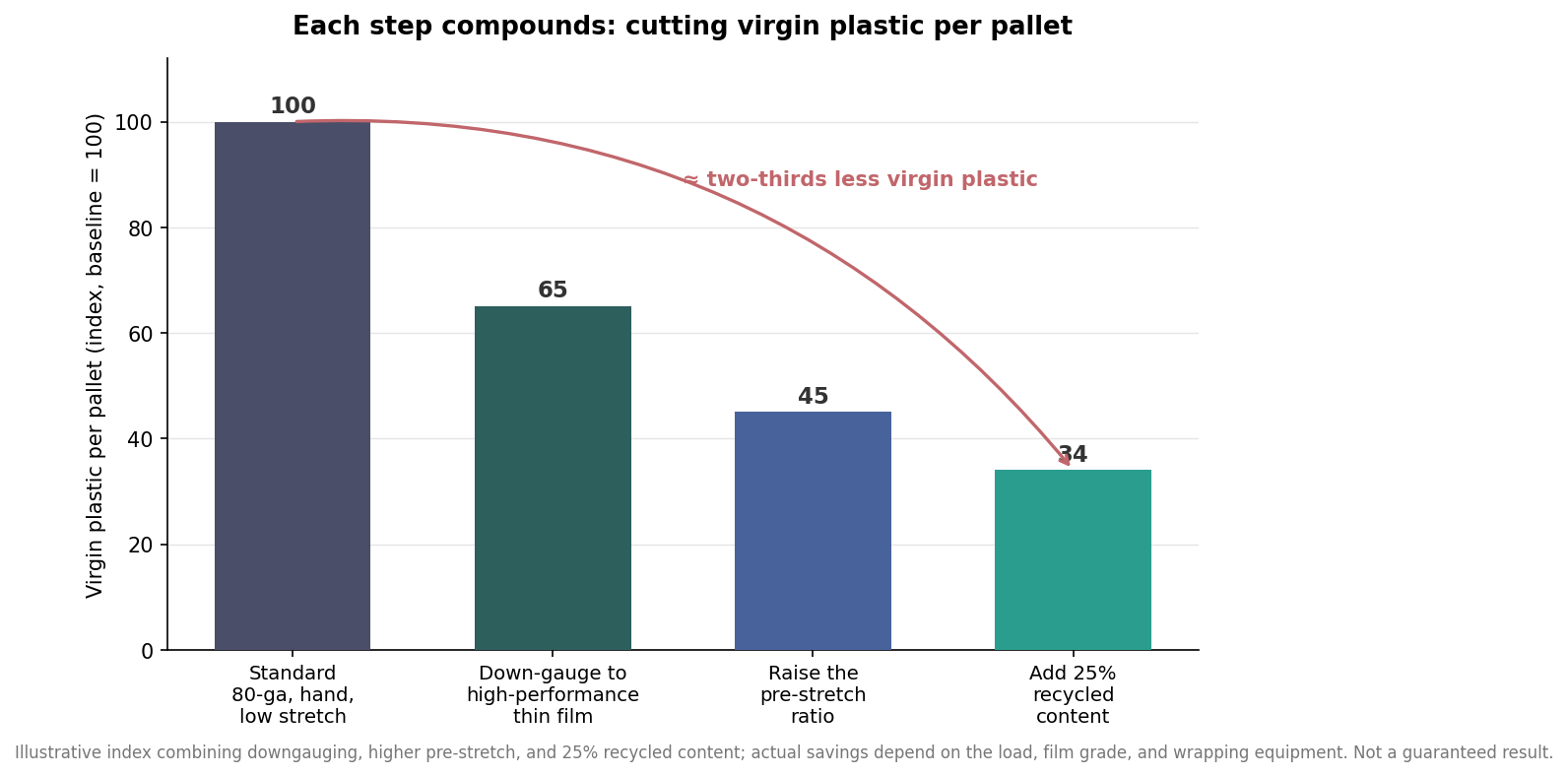
Stacked together, these levers compound. A warehouse that down-gauges to a high-performance film, raises its pre-stretch ratio, and then specifies recycled content can cut the virgin plastic behind each pallet substantially — the illustration above shows how the steps multiply rather than simply add. Treat the exact figure as directional; the point is that the reductions stack.
Lever three: recover the film you do use
Even an optimized operation still consumes film, and the sustainability story is only complete if that film comes back. Because a warehouse generates stretch wrap clean and concentrated, it is well suited to baling: collect the used film, keep it dry and free of tape and labels, compact it in a baler, and sell or hand it to a film recycler. Clean, baled LLDPE has real resale value, and diverting it from the dumpster both reduces disposal cost and closes the loop that makes PCR film possible in the first place. Setting up a simple capture point at the unwrapping station is often the highest-impact change a facility can make, because it converts a waste stream into feedstock.
Watch the claims, and don’t trade away stability
Two cautions keep a sustainability program honest. First, be skeptical of films sold as “biodegradable” or “oxo-degradable” — many simply fragment into smaller pieces of plastic under specific conditions rather than truly composting, and several jurisdictions now restrict those claims. Recyclable PCR polyethylene is generally the more defensible route for industrial film. Second, never let a sustainability spec quietly reduce containment force below what the load needs; a failed pallet in transit wastes the product, the packaging, and the wrap all at once. Prove the new film holds the load first, then bank the plastic savings. A branded, custom-printed film sits comfortably on top of all three levers — the logo travels on a thinner, partly-recycled, recoverable wrap, which is a better marketing story than a plain one. Decide the film against your loads and your recovery setup, and “sustainable pallet wrap” becomes a measurable result rather than a label.
Leave a Reply