Stretch film is one of the few warehouse consumables where the cost is set less by what you buy than by how it is applied. Two facilities can wrap identical pallets, buy film at the same price per pound, and still see their film bills diverge by a third or more — because one of them is drawing far more raw plastic off the roll than the load actually needs. Pre-stretched film is the product built around closing that gap. Understanding what it does, and where it quietly falls short, is the difference between a real saving and a switch that leaves your loads looser than before.
What “Pre-Stretch” Actually Means
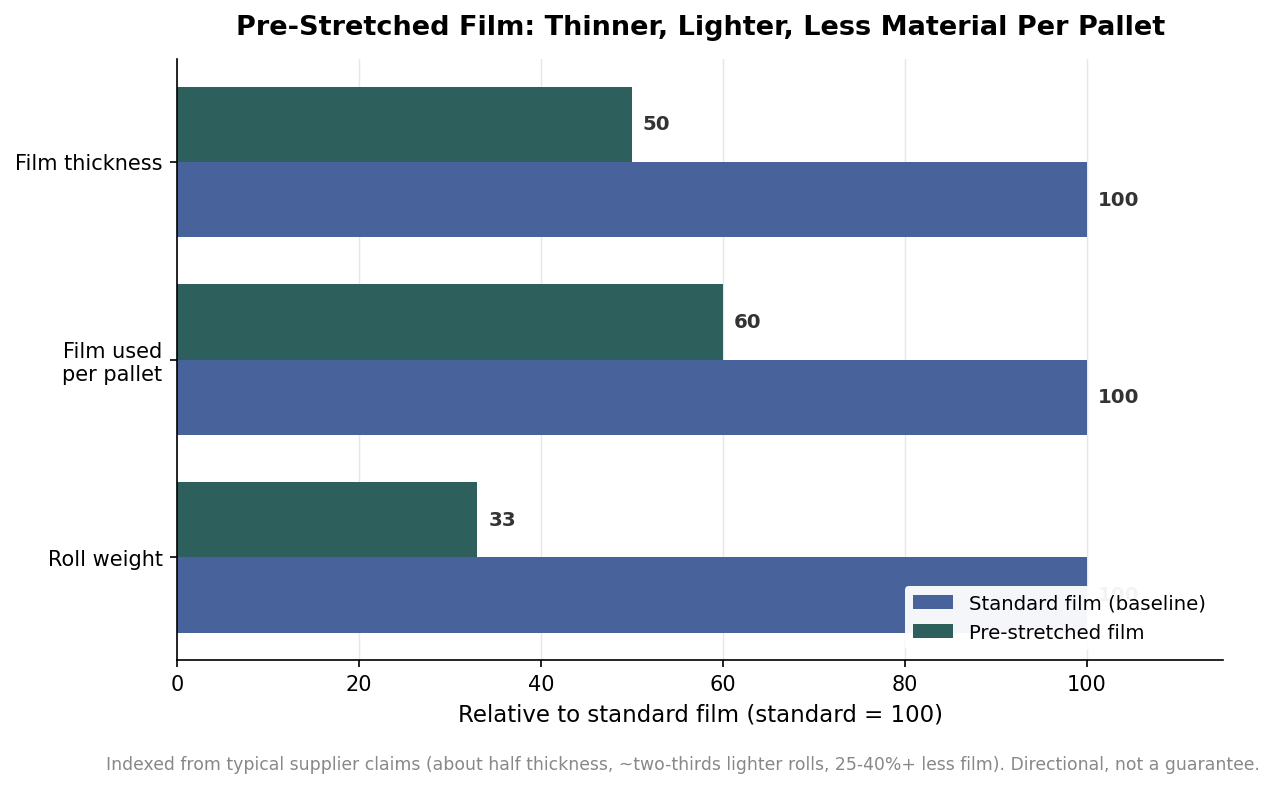
Ordinary stretch film arrives on the roll at its full thickness and is stretched as it is applied. Pre-stretched film is drawn out at the factory first — some products are pulled to roughly 90 percent of their capacity, close to the point where the film would break — and then wound onto the roll in that already-elongated state. The result is a thinner film that suppliers commonly describe as delivering similar strength at around half the thickness of a conventional equivalent. In effect, the stretching work that would normally happen in your warehouse has already been done in the plant, and you are buying the film in the condition it would end up in anyway.
The Number That Explains the Savings
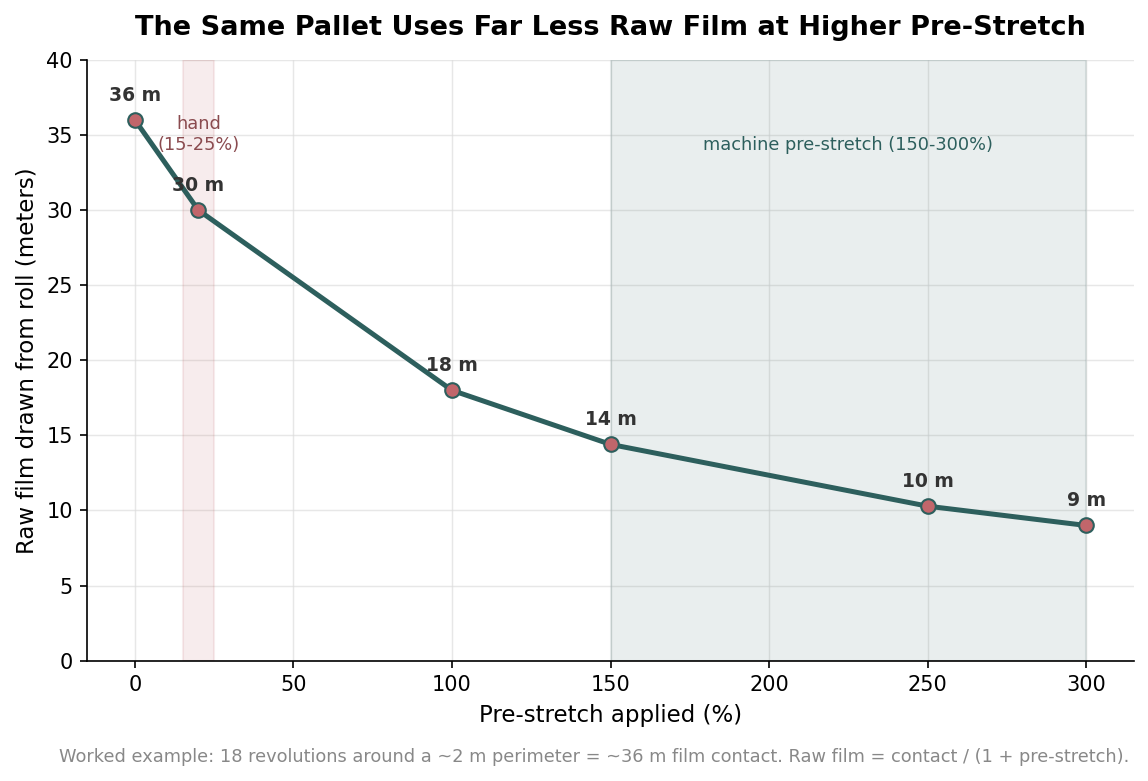
The reason this matters comes down to a single, uncomfortable figure: when film is applied by hand, operators typically achieve only about 15 to 25 percent stretch. Good film is engineered to stretch several times that — powered wrapping machines routinely run pre-stretch settings of 150 to 300 percent — so a hand-wrapped pallet is leaving most of the roll’s yield unused, paying for plastic that never does any work. Every extra bit of stretch you coax out of the film means fewer meters drawn from the roll to get the same number of turns around the load.
A worked example makes it concrete. A pallet with a roughly two-meter perimeter, wrapped for eighteen revolutions, needs about thirty-six meters of film in contact with the load. Drawn with no stretch at all, that is thirty-six meters off the roll. At a machine pre-stretch of 250 percent, the same coverage takes barely more than ten meters of raw film. Pre-stretched film brings a chunk of that efficiency to hand application, where operators otherwise never get close to it.
Where the Material and the Money Go
Because a pre-stretched roll is thinner and already elongated, less plastic goes onto each pallet. Suppliers commonly report film-use reductions in the range of 25 to 40 percent, and in some hand-wrap operations replacing standard film the drop is larger still. The savings are not only in material. A pre-stretched roll can weigh on the order of two-thirds less than a conventional roll of comparable coverage, which is a real ergonomic gain for staff wrapping pallets by hand all day, and on automatic equipment the reduced film draw lowers motor load and energy use. Fewer roll changes, lighter lifting, and less plastic per load add up across a shift. There is a disposal angle too: less film applied per pallet means less film to pay to haul away or recycle at the other end, which is easy to overlook when only the purchase price is on the invoice.
Where Pre-Stretch Isn’t the Answer
Thinner film is a trade, not a free lunch. A film that has already given up most of its stretch at the factory has less reserve and, at a given point on the load, less raw material standing between a sharp corner and a puncture. For heavy, rigid, or sharp-edged freight — unbanded steel, exposed pallet nails, dense irregular stacks — a thicker standard gauge or a purpose-built reinforced film often protects the load better than a very thin pre-stretched one, even though it costs more per pallet. Pre-stretch also rewards good technique: because there is less margin to hide a bad wrap pattern, the base wraps at the pallet foot and a consistent spiral up and down the load matter more, not less. Matching gauge to load remains the first decision — light, stable cartons tolerate a thin high-yield film that a drum of hardware would tear through.
Specifying It for a Branded Run
If you are ordering custom-printed film, the same logic applies, with a couple of extra checks. Decide first whether the film will be applied by hand or by machine, because that sets which pre-stretch grade and gauge make sense; a hand-applied branded film sees very different tension than one running through a powered pre-stretch head. Ask the supplier for the roll’s yield expressed as square feet or square meters per roll rather than judging by roll diameter, since a thinner high-yield roll can out-cover a fatter conventional one. Establish a baseline of how many revolutions and how many rolls your current setup uses per pallet, so you can measure any change honestly after switching. And wrap a few real loads with a sample before committing a full print run, checking both containment and puncture on your actual freight.
The figures here are industry-typical ranges, not quotes — stretch percentages, yields, and savings all depend on your film, your equipment, and your loads — so treat them as the shape of the opportunity and confirm the specifics with sample rolls and your supplier’s yield data before you rewrite the standing order.
Leave a Reply