Good artwork for custom stretch wrap is a bold, simple logo in clean vector form, printed in a high-contrast ink and laid out as a repeat that still reads after the film stretches. Customized Stretch Wrap turns the logo you already have into that layout, returns a free mockup within 24 hours, and prints nothing until you approve the design.
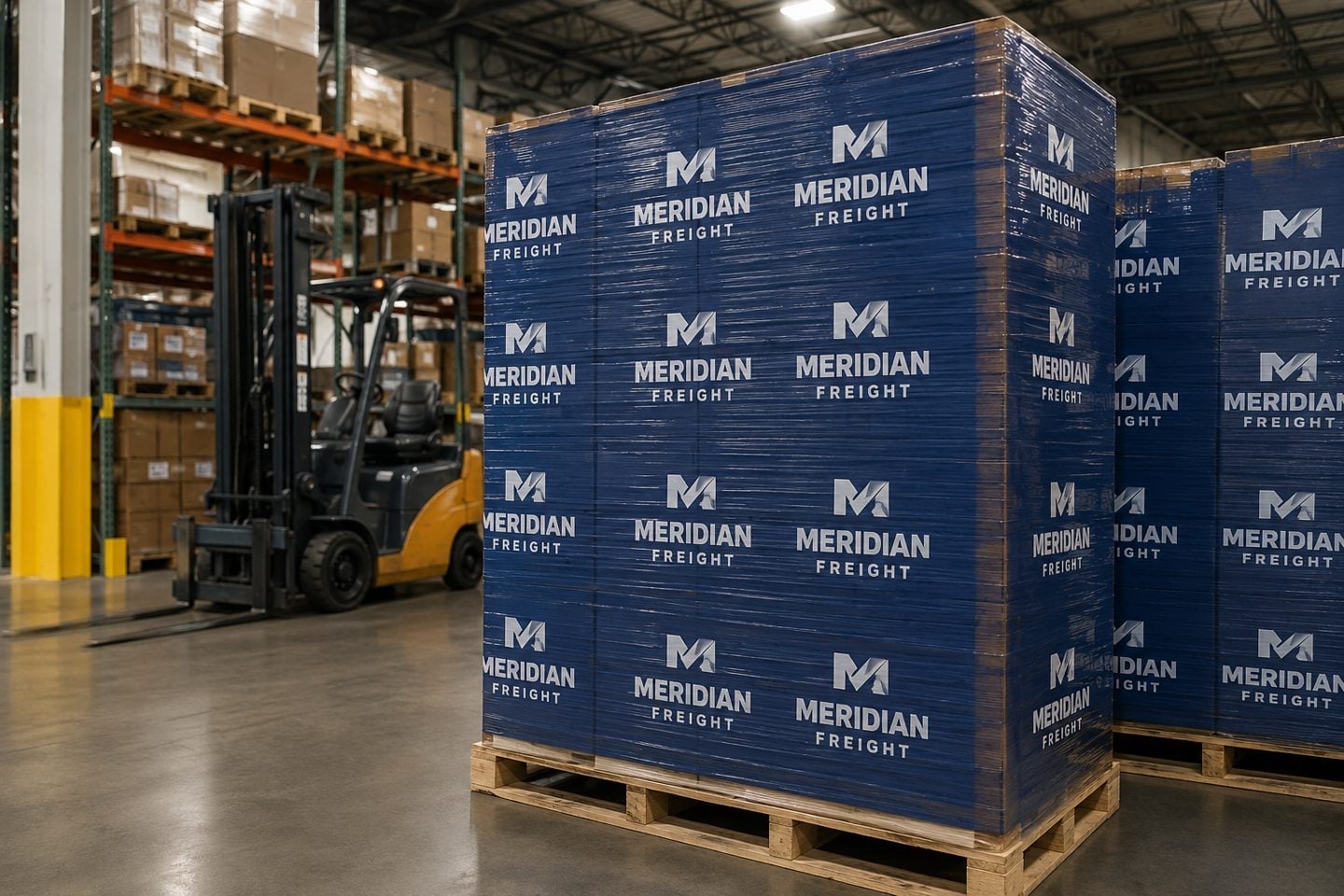
- Bold, simple logos survive stretching better than thin lines, gradients or photos.
- Ink color should contrast with the film and with the pallet contents behind it.
- A free mockup arrives within 24 hours, with unlimited free revisions.
- Nothing is charged until the design is approved; the minimum order is 12 rolls.
- Standard turnaround after approval is about two weeks.
What artwork does a printer need for custom stretch wrap?
A printer needs clean vector artwork of your logo to produce custom stretch wrap, plus any short line of text you want repeated around the load. Vector files keep edges sharp when a mark is scaled into a repeating pattern across a long roll. Customized Stretch Wrap reviews whatever you send and flags problems in the free mockup, which comes back within 24 hours.
If you only have a logo pulled from a website or an email signature, send it anyway. A low-resolution image is a starting point, not a dead end. The art team can often rebuild a simple mark, and the mockup shows you exactly how the rebuilt version will look before anything is printed.
Beyond the logo itself, gather the details that change the layout:
- The exact wording of any tagline, phone number or website you want printed.
- Brand color references from your style guide, if you have one.
- The film you plan to order, such as hand stretch wrap or machine stretch wrap, since roll format affects how the repeat is laid out.
- Whether the film is clear or tinted, because the background color changes how the ink reads.
Why does a logo look different once stretch wrap is pulled around a pallet?
A logo looks different on applied stretch wrap because the film elongates as it goes on the load, and the printed artwork stretches with it. Artwork that looks balanced on a flat proof gets wider and lighter once the film is pulled tight around a pallet. Good stretch wrap artwork is designed for the stretched state, not the flat roll.
Two things happen during wrapping. First, the mark elongates in the direction the film is pulled, so round shapes become ovals and tight letter spacing opens up. Second, the ink layer thins as the film thins, so solid areas appear less dense than they did on the unwound roll.
Overlap matters too. Stretch wrap is applied in layers, and each pass sits partly over the last. Where printed film overlaps printed film, two copies of the design can sit on top of each other. Bold, simple marks survive this. Fine detail and small type turn into noise.
The practical lesson is to judge your artwork by how it will read on the side of a wrapped pallet from across a dock, not by how it looks on a screen at full zoom. Ask to see the mockup in context before you approve.
Which logo designs print best on stretch film?
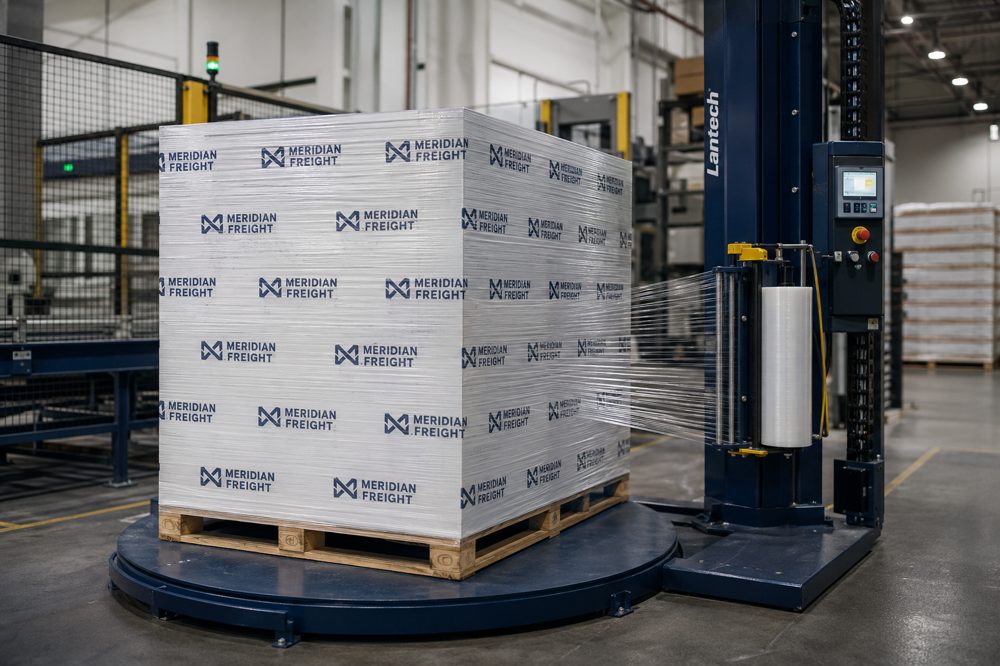
The logos that print best on stretch film are bold, simple and high in contrast: a strong wordmark, a solid icon, or both side by side. Heavy letterforms, open counters and clear shapes hold up when the film stretches and overlaps. Thin script, gradients, photographs and tiny taglines are the elements most likely to disappear on a wrapped load.
| Design element | How it reads on wrapped film | What to do |
|---|---|---|
| Bold sans-serif wordmark | Reads clearly from a distance | Use as the primary element |
| Solid icon or symbol | Holds its shape when stretched | Pair with the wordmark or use alone |
| Thin script or serif type | Breaks up and loses legibility | Switch to a heavier weight or simplify |
| Gradients and shading | Flattens or turns blotchy | Convert to solid flat color |
| Photographs | Poor detail on thin film | Leave off the wrap |
| Small taglines and fine print | Too small to read on a moving pallet | Cut or enlarge |
Many brands keep a simplified version of their logo for embroidery or signage. That version is usually the right starting point for stretch wrap, too.
How should ink colors be chosen for clear or tinted stretch wrap?
Ink colors for stretch wrap should be chosen for contrast against the film, not only for brand accuracy. On clear film, the pallet contents show through behind the print, so dark, saturated inks read best. On tinted stretch film, the ink has to stand out against the tint itself.
Consider what sits behind the wrap. A logo printed in a mid-tone color can vanish against brown corrugated cases, and a dark logo can blend into black totes or dark product. If most of your pallets carry the same kind of packaging, design the color choice around that background.
Fewer colors usually produce a cleaner result on stretch wrap. A single strong brand color is easier to keep consistent from run to run, and it keeps the design readable when layers overlap. If your logo uses several colors, ask whether a single-color version still looks like your brand. Customized Stretch Wrap will show both options in the mockup so you can compare them side by side.
When brand color matters, send the reference from your style guide rather than a screen sample. Screens vary, and the mockup is a guide to layout, not a color-matched proof of ink on film.
How is a logo laid out as a repeating pattern on a roll?
A logo on custom stretch wrap is laid out as a repeating pattern that runs down the length of the roll, so the mark appears again and again on every side of the wrapped load. The layout sets how large each logo is, how far apart the copies sit, and whether text alternates with the icon.
Spacing is a trade-off. Tight spacing puts a logo on every face of the pallet even on short wraps, but it can look busy and overlapping layers may collide. Wider spacing looks cleaner but can leave a side of the load blank if the operator uses fewer passes.
Common layout choices include:
- Single-mark repeat: one logo repeated at even intervals. Simple and bold.
- Logo and message repeat: the logo alternates with a short line such as a website or a handling note.
- Staggered repeat: copies offset row to row, which helps fill a wide roll without stacking marks directly over each other.
For machine rolls on a turntable wrapper, the film is usually pre-stretched more aggressively than hand film, so layouts often need extra room between marks. The mockup shows the repeat at the roll width you plan to order.
What artwork mistakes should you avoid on a first stretch wrap order?
The most common artwork mistakes on a first custom stretch wrap order are sending a busy full-color logo, using text that is too small, picking an ink that disappears against the product, and approving a flat mockup without thinking about stretch. Each one can be caught at the mockup stage if you know to look for it.
- Using the full marketing logo. Taglines, badges and fine outlines rarely survive on film. Start from the simplest approved version of the mark.
- Packing in too much information. Stretch wrap is a recognition tool, not a brochure. A logo plus one short line is usually the ceiling.
- Ignoring the background. Check the design against the actual cases, drums or totes it will cover.
- Forgetting the people who handle the load. Handling notes such as “do not double stack” need to be large and repeated so a forklift driver can read them on any face.
- Skipping internal sign-off. Marketing, operations and purchasing may each care about different details. Collect their notes before you approve.
Customized Stretch Wrap includes unlimited free revisions, so there is no cost to asking for another round until the layout is right.
How do proofs and approval work before printing starts?
Proof approval for custom stretch wrap works in a simple loop: you send artwork, Customized Stretch Wrap returns a free mockup within 24 hours, you request changes as often as needed, and printing starts only after you approve. You pay nothing until the design is approved, so the proof stage carries no risk.
- Submit your request through the custom quote form with your logo, film type and rough quantity. The minimum order is 12 rolls.
- Review the mockup for logo size, spacing, ink color and any text. Check spelling on every word.
- Request revisions until the layout reads well. Revisions are unlimited and free.
- Approve the final design, and production begins. Standard turnaround is about two weeks, with faster turnaround available through express shipping.
Save the approved file and the mockup together. When you reorder, referencing the approved design keeps future runs consistent, and any change, such as a new phone number, can be made on the same artwork. The full sequence is described on the how it works page.
Should different film types use the same stretch wrap artwork?
Different film types can share one stretch wrap design, but the artwork often needs small adjustments for each. Hand rolls, machine rolls, pre-stretched hand film and bundling film differ in width and in how much they stretch on application, and those differences change how a logo repeat reads.
Narrow bundling film leaves less room for a wide wordmark, so a compact icon may work better there. Pre-stretched film has already been elongated before it reaches you, so it stretches less at the pallet and the artwork behaves closer to the flat proof. Machine film may be stretched heavily on the wrapper, which calls for more space between marks.
If you order several formats, ask for a mockup of each one rather than assuming a single layout fits all. Keeping the logo, colors and wording identical across formats, while adjusting size and spacing, gives every pallet a consistent look. Manufacturers running mixed lines often take this approach, as covered on the custom stretch wrap for manufacturers page.
Frequently asked questions
Does custom stretch wrap artwork have to be designed by a professional designer?
Custom stretch wrap artwork does not need to come from a professional designer. Most buyers send the logo they already use, and Customized Stretch Wrap adapts it into a repeating layout suited to film. If the file needs cleanup, the art team handles it and shows the result in the free mockup, so you can judge the finished look before you approve anything.
Can a low-resolution logo be used for printed stretch wrap?
A low-resolution logo can still be the starting point for printed stretch wrap. Simple marks can often be rebuilt as clean artwork, and the mockup shows how the rebuilt version will look on film. Complex marks with fine detail may need simplifying. Sending the best file you have, even a screenshot, lets the team tell you quickly what is possible.
Will thin lines in a logo print clearly on stretch wrap?
Thin lines in a logo often print poorly on stretch wrap because the film elongates and thins during wrapping, which breaks up delicate strokes. Heavier line weights hold their shape far better. If your mark relies on hairline outlines or fine script, ask Customized Stretch Wrap to show a bolder version in the mockup and compare the two before approving.
Should stretch wrap text be printed in capital letters?
Stretch wrap text often reads better in bold capital letters, especially for short handling notes or a brand name meant to be seen across a dock. Capitals keep a steady shape when stretched. Longer lines such as a website address can stay in their normal case if the letterforms are heavy. The mockup is the best place to test both.
Can a website or phone number be added to a custom stretch wrap design?
A website or phone number can be added to a custom stretch wrap design, usually as a short line that alternates with the logo in the repeat. Keep the wording brief and the type large so it stays readable after stretching. Customized Stretch Wrap will place the line in the mockup, and it can be updated on future reorders.
How large should a logo be on custom stretch wrap?
Logo size on custom stretch wrap is set by the roll width and how far the film stretches on your loads. The goal is a mark large enough to read from across a dock while still repeating on every face of the pallet. Customized Stretch Wrap proposes a size in the free mockup, and you can request larger or smaller.
Can stretch wrap artwork include a QR code?
Stretch wrap artwork can include a QR code, but the code may distort once the film is stretched around a load, which can make it hard to scan. Treat any QR code on stretch wrap as a test rather than a guarantee. Ask Customized Stretch Wrap to show it in the mockup and weigh it against a plain printed web address.
Does the color of the pallet contents affect stretch wrap ink choice?
The pallet contents affect stretch wrap ink choice because clear film lets the cases, drums or bags show through behind the print. A mid-tone ink can disappear against brown corrugated, while a dark ink can blend into dark product. Choose an ink with strong contrast against whatever usually sits under the wrap on your loads.
Who should sign off on a stretch wrap mockup inside a company?
A stretch wrap mockup is best approved by both the person who owns the brand and the person who runs the dock. Marketing checks the logo and colors, while operations confirms the film type and any handling notes. Customized Stretch Wrap offers unlimited free revisions, so gathering everyone's comments first costs nothing but a little time.
Can a stretch wrap design be changed after the first order is printed?
A stretch wrap design can be changed for any future run after the first order is printed. Updates such as a new logo, revised tagline or different ink color go through the same process: a fresh free mockup within 24 hours, revisions as needed, and approval before printing. Rolls already produced keep the earlier design.
Is a separate mockup needed for tinted stretch film?
Tinted stretch film should get its own mockup because the tint changes how ink colors read. A color that pops on clear film may look muddy against a tint. Customized Stretch Wrap can show the same logo on clear and tinted film side by side, so you can confirm contrast before committing to either one.
Get a free mockup for your stretch wrap
Send your logo or idea and the quantity you have in mind. Customized Stretch Wrap returns a free mockup within 24 hours, you approve the design before anything is produced, and standard turnaround is about two weeks with faster options available. Get a custom quote.